About Ivan's Childhood
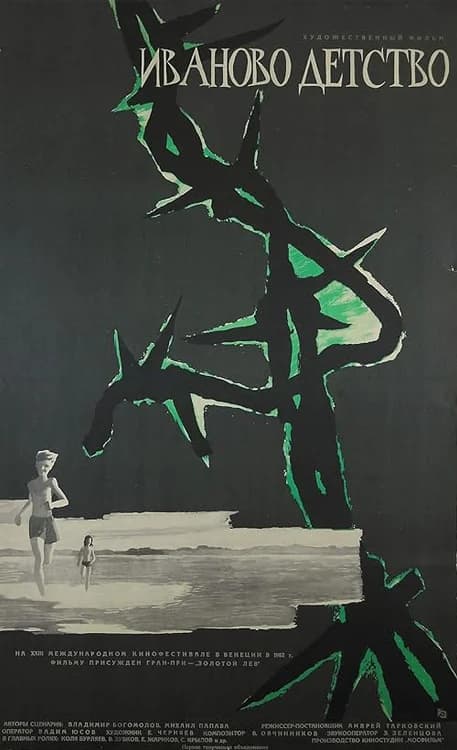
Andrei Tarkovsky's debut feature 'Ivan's Childhood' (1962) remains a landmark of Soviet and world cinema, offering a profoundly moving exploration of war's impact on innocence. The film follows 12-year-old Ivan, a hardened orphan who serves as a scout for the Soviet army during World War II, navigating the brutal Eastern Front with a maturity far beyond his years. Through Ivan's eyes, we witness the devastating cost of conflict as he forms fragile connections with three sympathetic officers who become surrogate father figures.
Tarkovsky's direction is masterful, blending stark realism with poetic dream sequences that contrast Ivan's traumatic present with memories of a lost childhood. Nikolai Burlyaev delivers a remarkable performance as Ivan, capturing both the character's fierce determination and vulnerable humanity. The black-and-white cinematography creates a haunting visual landscape that perfectly complements the film's themes of memory, loss, and the destruction of innocence.
What makes 'Ivan's Childhood' essential viewing is its unique approach to war storytelling. Rather than focusing on battlefield heroics, Tarkovsky examines psychological trauma and the irreversible theft of youth. The film's emotional power lies in its subtlety and the spaces between dialogue, where dreams and reality intersect. For viewers interested in cinematic artistry, historical drama, or profound human stories, this early Tarkovsky masterpiece offers an unforgettable experience that continues to resonate decades after its release.
Tarkovsky's direction is masterful, blending stark realism with poetic dream sequences that contrast Ivan's traumatic present with memories of a lost childhood. Nikolai Burlyaev delivers a remarkable performance as Ivan, capturing both the character's fierce determination and vulnerable humanity. The black-and-white cinematography creates a haunting visual landscape that perfectly complements the film's themes of memory, loss, and the destruction of innocence.
What makes 'Ivan's Childhood' essential viewing is its unique approach to war storytelling. Rather than focusing on battlefield heroics, Tarkovsky examines psychological trauma and the irreversible theft of youth. The film's emotional power lies in its subtlety and the spaces between dialogue, where dreams and reality intersect. For viewers interested in cinematic artistry, historical drama, or profound human stories, this early Tarkovsky masterpiece offers an unforgettable experience that continues to resonate decades after its release.